

Continuous improvement is an essential part of effective management. Although this may seem to involve standards, KPIs and process descriptions, for us it is primarily about communication: openly discussing challenges and collaborating to find solutions.
We are committed to continuously improving everything we do. This also means questioning processes that already work well. This is why KARL HUGO’s process owners and management team come together twice a year for a full day to review the way we work. What is working well? Where are we facing challenges? And how can we improve together?One table, many perspectives
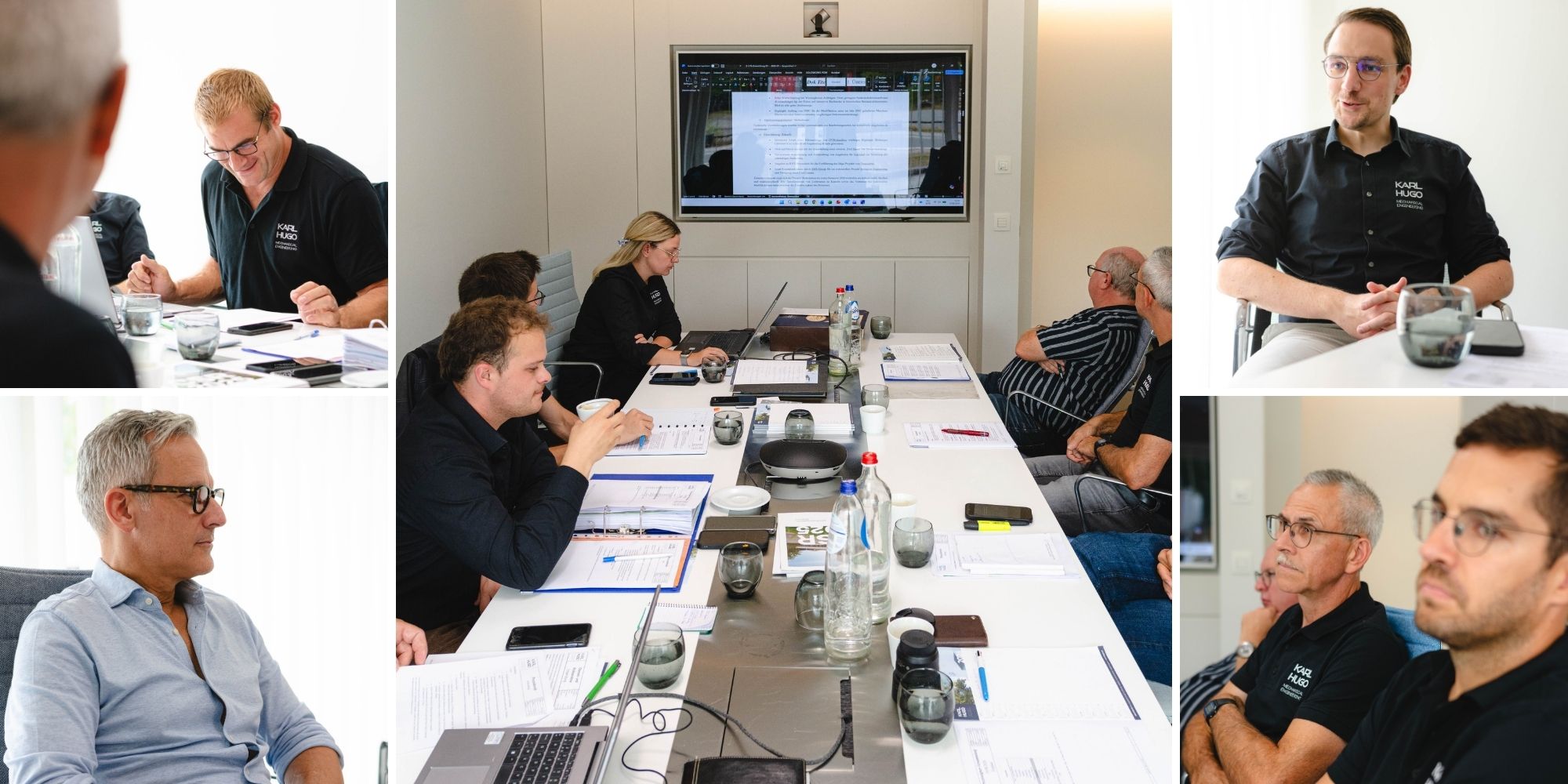
A total of eleven people take part in our Process Owners’ Meeting. Management and Process Owners from Administration, Sales, Planning, Development, Production, Quality Assurance, Environmental Management, Occupational Health and Safety, Human Resources, Finance, Purchasing and IT all come together around the same table – and, above all, as equals.Each area brings its own experience, challenges and perspectives. After all, a problem rarely affects just one part of the company. A challenge in Production, for example, can also have an impact on Planning, Human Resources or Quality. This is where we rely on collective intelligence: when different experiences, expertise and perspectives come together, solutions emerge that an individual or a single department might not have arrived at on their own.
That is why we deliberately avoid the mindset of: “That’s another department’s responsibility.” We look at our processes together.
Taking stock twice a year
The Process Owner Meeting is held twice a year, typically at the end of February or beginning of March, and again at the end of August or beginning of September.At the start of each year, we review the previous financial year, analyse process reports and KPIs, and evaluate opportunities and risks. During the Management Review, we also set our objectives for the year ahead.
Around six months later, we take stock again. Where do we stand? What new challenges have emerged? Where might we need to take early action?
This process also helps us to identify practical risks. For example, if critical expertise is concentrated in the hands of an employee who is approaching retirement, we need to address the issue early. How can we retain this know-how and ensure an effective knowledge transfer?
From identifying an issue to taking action
Training is a good example of how these discussions can lead to practical improvements.During a previous Process Owner Meeting, we identified training needs across several departments. Fewer training sessions had taken place over a long period of time, while new colleagues had also joined our teams.
What initially appeared to be a number of individual observations developed into a cross-departmental issue. Ultimately, this led to a concrete measure: we organised a dedicated training afternoon to address the identified knowledge gaps.
The process is simple: identify the issue, discuss it together and implement a concrete measure. That is exactly what our Process Owner Meeting is about!
“Good” is not the finish line
Excellence does not come from defining processes correctly once and leaving them unchanged. It comes from taking a close look, learning from one another and continuously questioning the way things are done.Not every topic will immediately result in a new measure. Some issues can be resolved through discussion, while others require further monitoring. Where action is needed, we initiate improvements and consistently follow up on them.
This is what continuous improvement means at KARL HUGO: not an abstract management concept, but an integral part of the standards we set ourselves.

