

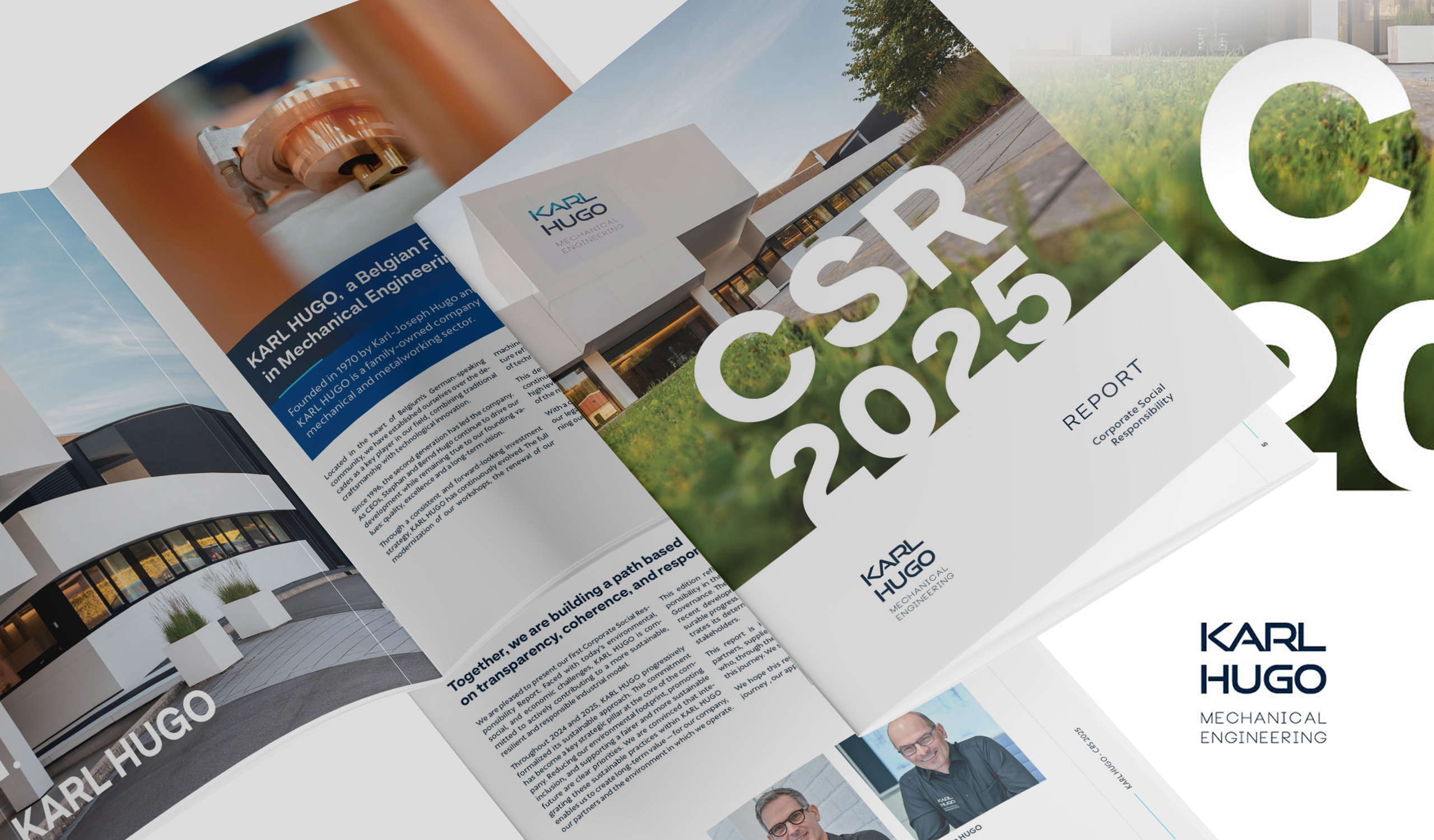
With the aim of structuring and transparently presenting our activities in the areas of environmental, social, and corporate governance, we published our first sustainability report in 2025.
This report is the result of an intensive, cross-functional process in which we consciously reflected on our role and responsibilities as a company. It goes beyond numbers: we sought to understand the impact of our activities on the environment and society, and how we can shape this impact positively in the long term.Together, we reviewed existing measures, developed new perspectives, and defined key areas for action. The result is not only a report, but also a clear view of where we stand today and where we aim to go.
Our CSR report is therefore more than a status overview – it reflects our mindset: taking responsibility and creating long-term value for our employees, customers, and partners.
In the following article, we provide insights into our approach and the key steps behind this sustainability report.
Step 1: Our Stakeholders at the Core
A central question in our report is: Who are we actually responsible to?Together with process owners and management, we conducted a comprehensive stakeholder analysis. All relevant stakeholder groups — from employees and clients to suppliers, authorities and the local community — were systematically evaluated.
The result is a stakeholder matrix that maps influence and interest. This helps us to set priorities, understand expectations better, and align our communication accordingly.
One key insight that emerged is that employees, clients and partners are at the core of our activities. Actively involving these groups is essential for our long-term success.
Step 2: Double Materiality – Two Perspectives, One Objective
Through the double materiality analysis, we assess sustainability from two complementary perspectives:- Inside-out: What impact do our activities have on the environment and society?
- Outside-in: Which external developments influence our company?
The analysis is based on the IRO model (Impact, Risk & Opportunity) and aligned with ESG criteria, providing a comprehensive view of our interactions with our environment.
Step 3: Our First Carbon Footprint
Another key milestone was the development of our first Carbon Footprint Analysis.For the first time, we assessed our emissions across the entire value chain (Scopes 1, 2 and 3). The result: 4,474 tonnes of CO₂ equivalent in 2023.
Around 90% of these emissions originate from:
- Inputs (e.g. raw materials): 73%
- Capital goods: 10%
- Energy: 7%.
Step 4: ISO 14001 – Creating Structure
Sustainability requires structure. That is why we are currently implementing an Environmental Management System in accordance with ISO 14001.This system enables us to continuously improve our environmental performance, identify risks, and manage actions in a structured way. It is also integrated into our existing quality management system.
Our objective is to achieve certification in 2026.
Step 5: From Workshop to Implementation
A key milestone in our journey was our first company-wide sustainability workshop. For one afternoon, we paused daily operations to reflect on challenges, opportunities and concrete actions together. Our approach: bottom-up rather than top-down.One tangible outcome of this workshop was the establishment of our internal Sustainability Committee. Composed of dedicated employees from various departments and levels, the committee drives new ideas and acts as a link to management.
This ensures that sustainability at KARL HUGO is not only a strategic concept, but is also actively embraced in our day-to-day work.
Sustainability as a Shared Journey
Our first CSR report is not an end in itself, but a starting point.It creates transparency, tracks our progress and defines clear priorities for the future. Above all, it demonstrates that sustainability at KARL HUGO is a collective endeavour, driven by dedication, accountability, and ongoing improvement.
The full Sustainability Report is available here.

